The L1A to EB1C Roadmap: A Fast Track to US Permanent Residency
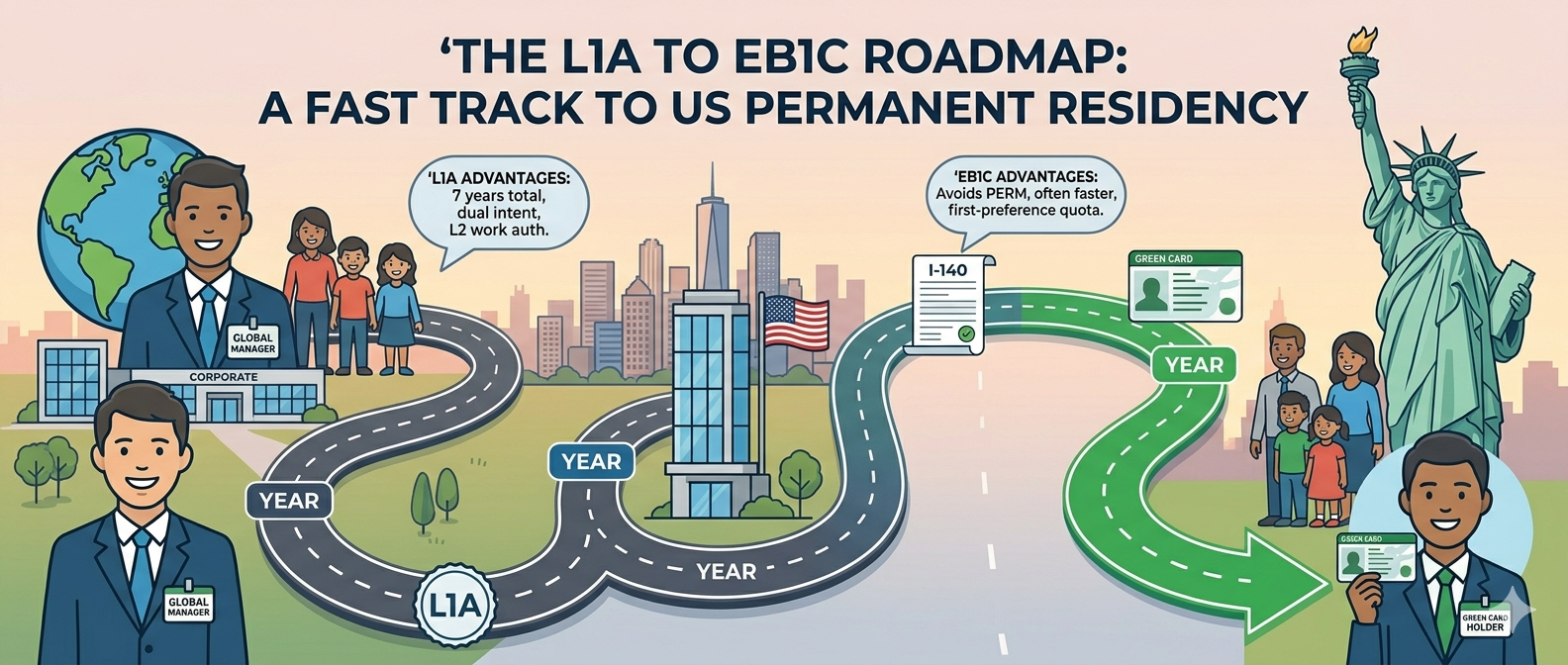
For Indian executives and managers moving to the United States on an L1A visa, the long-term goal is often achieving permanent residency (a Green Card). While the EB-2 and EB-3 categories are notorious for decade-long wait times for Indian nationals, the EB1C category offers a significant advantage.
In this guide, we break down the strategic transition from L1A status to an EB1C Green Card.
What is the EB1C Category?
The EB1C (Multinational Executive or Manager) category is part of the first-preference employment-based immigrant visa. It is specifically designed for managers and executives of multinational companies who are being transferred to the US in a permanent capacity.
Why It’s the "Fast Track"
- No Labor Certification (PERM): Unlike most other employment-based Green Cards, the EB1C does not require a PERM Labor Certification from the Department of Labor. This saves 12-18 months of processing time.
- Concurrent Filing: In many cases, you can file your I-140 (Immigrant Petition) and I-485 (Adjustment of Status) concurrently, allowing you to get your EAD (Work Permit) and Travel Document much faster.
Eligibility Alignment: L1A vs. EB1C
The criteria for L1A and EB1C are remarkably similar, which is why the transition is so common.
1. The Qualifying Relationship
The US employer must be the same employer (or a parent, subsidiary, or affiliate) of the company that employed you abroad. This relationship must have existed for at least one year.
2. The Executive or Managerial Role
You must have been employed in a managerial or executive capacity for at least one out of the three years prior to your transfer to the US. Your role in the US must also be managerial or executive.
- Executive: Primarily directs the management of the organization or a major component.
- Managerial: Primarily manages the organization, a department, or a function. This can include "Function Managers" who manage an essential business function rather than people.
The Strategic Steps to Success
Step 1: Establish the US Office (for New Offices)
If you moved on a "New Office" L1A, you must demonstrate that the US business is active and viable after one year. This involves showing revenue, a growing team, and established operations.
Step 2: Solidify the Management Structure
For EB1C, USCIS looks closely at the organizational chart. You need to show that you are managing professional-level subordinates or a critical business function. A "flat" structure is often a red flag for EB1C petitions.
Step 3: Timing the Filing
While you can theoretically file for EB1C shortly after arriving, we generally recommend having at least 6-12 months of US payroll and operational data to strengthen the case.
Common Pitfalls to Avoid
- Doing Too Much "Doing": If you are performing the day-to-day tasks of the business rather than managing people or functions, USCIS may argue your role is not truly managerial.
- Inadequate Staffing: For small startups, you must show that you have enough staff to handle the non-managerial duties.
- Vague Job Descriptions: Generic job duties lead to RFEs (Requests for Evidence). Detailed, percentage-based breakdowns of your managerial activities are essential.
How Visawala Can Help
The transition from L1A to EB1C is a high-stakes process. At Visawala Solutions, we specialize in:
- Organizational Design: Helping you structure your US team to meet strict EB1C requirements.
- Document Preparation: Crafting detailed managerial job descriptions and business plans.
- RFE Defense: Leveraging our deep experience to overcome complex USCIS challenges.
Ready to start your journey to US Permanent Residency? Book a consultation with our experts today.
Disclaimer: The information provided in this article is for general informational purposes only and does not constitute legal advice.