US Business Visa Checklist for Indian Entrepreneurs 2026 (Complete Guide)
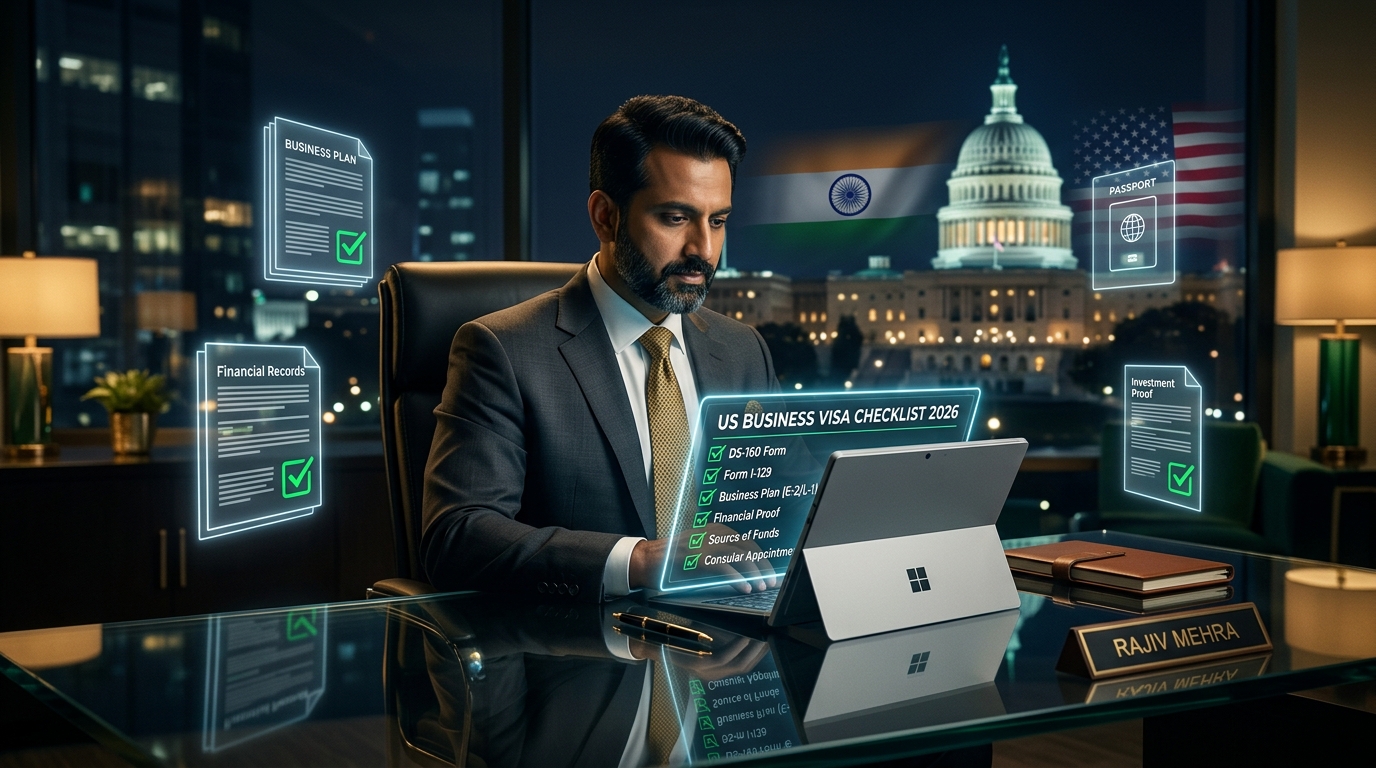
Planning to take your Indian business to the United States? Getting the right visa is the single most critical step — and submitting an incomplete or incorrect application costs you months of time and thousands of dollars in fees.
This guide gives you the exact, updated 2026 checklist for every major US business visa category used by Indian entrepreneurs. Bookmark it, print it, use it.
First: Which Visa Do You Actually Need?
Before pulling out documents, let's match your situation to the right visa:
| Your Situation | Best Visa | |---|---| | You own a company in India and want to work in the US entity | L1A or L1B | | You want to attend meetings, conferences, or short business trips | B-1 Business Visitor | | You want to invest substantially and run a US business | E-2 Treaty Investor | | You want to invest $800K+ for a US green card directly | EB-5 Investor Visa | | You want to transfer specialized skills to your US office | L1B | | You're a startup founder with extraordinary ability | O-1 or EB-1A |
Most Indian entrepreneurs expanding operations to the US will choose L1A (Managers/Executives) or L1B (Specialized Knowledge Workers).
Section 1: L1A Visa Checklist (Managers & Executives)
This is the most popular visa for Indian founders and business owners expanding to the US.
Part A: Employer's Petition Documents (Form I-129)
- [ ] Form I-129 — Petition for Nonimmigrant Worker (filed by the US entity)
- [ ] Form I-129 L Supplement — L Classification Supplement
- [ ] USCIS Filing Fee — $730 (base) + $600 (fraud detection levy) + $2,805 (premium processing, strongly recommended)
- [ ] Employer Support Letter — Signed by an authorized officer of the US company
Part B: Qualifying Relationship Documents
- [ ] Certificate of Incorporation / Certificate of Formation of the US Company
- [ ] Certificate of Incorporation / MoA & AoA of the Indian Company
- [ ] Shareholding pattern or share certificates showing common ownership
- [ ] Operating Agreement (US LLC) or Board Resolutions showing same beneficial owner
- [ ] Organizational chart of both entities showing ownership structure
Part C: Petitioner's Employment History (India)
- [ ] Employment offer letter or appointment letter from the Indian company
- [ ] Salary slips / payslips for the past 12 months minimum
- [ ] Form 16 / Income Tax Returns for 2+ years
- [ ] Any appraisal letters or promotion letters showing managerial progression
- [ ] Proof of 1 full year of employment within the last 3 years (joining–leaving dates)
Part D: Managerial/Executive Role Evidence
- [ ] Detailed Petitioner's Letter describing:
- Organizational structure in India
- Number of people you directly manage (names and titles)
- Your specific managerial duties (60%+ of time)
- How management decisions are made
- [ ] Org chart of Indian company with names and reporting lines
- [ ] Job Description for the US role (must be managerial/executive)
- [ ] Evidence of business relationships (vendor contracts, client agreements, lease)
Part E: US Entity Business Documents
- [ ] US Company EIN (Employer Identification Number)
- [ ] Signed commercial lease agreement for US office
- [ ] US bank account statements (if any)
- [ ] Business plan (essential for new office petitions): 2-year projection with staffing plans, revenue targets, and market strategy
- [ ] Client contracts or Letters of Intent (if available)
Part F: Personal Documents (For DS-160 / Consular Processing)
- [ ] Valid Indian Passport (must be valid for 6+ months beyond intended stay)
- [ ] Passport-size photograph (2×2 inches, white background, taken within 6 months)
- [ ] Previous US visa copies (if any)
- [ ] DS-160 Nonimmigrant Visa Application (completed online at ceac.state.gov)
- [ ] Visa appointment confirmation slip (from VFS Global or US Embassy portal)
- [ ] MRV Fee receipt ($205 USD)
- [ ] SEVIS Fee receipt (if applicable)
Section 2: L1B Visa Checklist (Specialized Knowledge Workers)
All documents from L1A checklist PLUS:
- [ ] Specialized Knowledge Letter — A detailed written explanation covering:
- What proprietary process, product, or system you have expertise in
- Why this knowledge is not commonly available in the US
- How long it took to acquire this knowledge
- How your knowledge benefits the US entity
- [ ] Technical documentation proving the proprietary nature of your knowledge (architecture docs, patents, internal manuals)
- [ ] Evidence you've trained others on this knowledge
- [ ] Client emails or testimonials referencing your specific expertise
- [ ] Performance reviews highlighting specialized skills
- [ ] Any patents, publications, or certifications in your domain
⚠️ L1B Tip: The USCIS definition of "specialized knowledge" is narrow. Generic IT skills (Java, Python, React) without company-specific context will get an RFE. Document the company-specific application of your knowledge.
Section 3: B-1 Business Visitor Visa Checklist
Use this if you're visiting the US for meetings, negotiations, conferences, or due diligence — not to work or earn a US salary.
Application Documents:
- [ ] Valid Indian Passport
- [ ] DS-160 Online Application
- [ ] MRV Fee payment ($185 USD for B-1/B-2)
- [ ] Appointment confirmation (VFS or US Embassy)
Supporting Documents at Interview:
- [ ] Cover letter explaining the purpose of your visit
- [ ] Invitation letter from the US company/conference organizer (on their letterhead)
- [ ] Itinerary of meetings or conference schedule
- [ ] Business cards, company ID card
- [ ] Recent 3 months bank statements (showing strong financial ties to India)
- [ ] Income Tax Returns (last 2 years)
- [ ] Property documents or family ties in India (to show you'll return)
- [ ] Return flight ticket (booked but changeable)
- [ ] Hotel booking confirmation
Common B-1 Denial Reasons to Avoid:
- Insufficient financial proof
- No clear itinerary of US business activities
- History of overstays
- Appearing to intend immigration, not just a business visit
Section 4: E-2 Treaty Investor Visa Checklist
Available for Indian nationals only after the US-India Bilateral Investment Treaty comes into effect — currently, India does not have an E-2 treaty with the US. However, Indian passport holders who have citizenship of an E-2 treaty country (e.g., UK, Germany, Japan through naturalization) can apply.
📌 Note: Watch for US-India trade treaty developments in 2026 that may open E-2 eligibility for Indian nationals.
If Eligible, Key Requirements:
- [ ] Substantial investment proof (minimum $50,000–$100,000 recommended; no fixed minimum)
- [ ] Evidence investment is "at risk" (not refundable)
- [ ] Business plan showing the enterprise is not "marginal" (will generate income beyond owner support)
- [ ] Proof of treaty nationality (passport of treaty country)
- [ ] At least 50% ownership of the US enterprise
Section 5: EB-5 Investor Visa Checklist (For Permanent Residency)
For Indian entrepreneurs with $800,000–$1,050,000 to invest in a US job-creating enterprise.
Minimum Investment Requirements (2026):
- $800,000 — In a Targeted Employment Area (TEA: rural or high unemployment)
- $1,050,000 — In a non-TEA location
Core Documents:
- [ ] Form I-526E (Regional Center investment) or Form I-526 (Direct investment)
- [ ] USCIS Filing Fee ($11,160 as of 2026)
- [ ] Proof of investment funds:
- [ ] Bank statements (3+ years)
- [ ] Source of funds declaration
- [ ] Income tax returns (India, 5+ years)
- [ ] Business valuation / audited financial statements
- [ ] Property sale documents, inheritance records (if applicable)
- [ ] Investment agreement with EB-5 Regional Center or direct project
- [ ] Business plan (for direct investments) showing 10 full-time US jobs created
- [ ] Background documentation (police clearance certificates)
💡 Priority Date Alert: As of 2026, EB-5 for Indian nationals is current for Regional Center investments. This is a rare window — act quickly as dates can retrogress.
Visa Interview Preparation: What Consular Officers Ask
Regardless of which visa you're applying for, prepare crisp answers to:
- "What does your company do?" — 2-sentence pitch of your Indian business
- "What will you be doing in the US?" — Specific role and activities
- "Why does the US company need YOU specifically?" — Your unique value
- "What is your annual salary in India?" — Know your exact compensation
- "Do you have any relatives in the US?" — Answer honestly; having relatives isn't disqualifying
- "When are you planning to return to India?" — Have a definite answer ready (for B-1)
- "Who owns the US company?" — Know the exact ownership structure
Processing Times & Fees Summary (2026)
| Visa | USCIS Filing Fee | MRV Fee | Premium Processing | Total Timeline (Standard) | |---|---|---|---|---| | L1A / L1B | $1,330 + $600 | $205 | $2,805 (15 days) | 5–8 months | | B-1/B-2 | N/A | $185 | N/A | 3–8 weeks | | E-2 | N/A | $315 | N/A | 2–6 months | | EB-5 (I-526E) | $11,160 | $325 | N/A | 24–48 months |
10 Expert Tips for First-Time Approval
-
File with premium processing for L1 visas — the 15-business-day window eliminates months of uncertainty.
-
Set up the US LLC before filing — You need a physical address and EIN. Don't file I-129 without the entity incorporated.
-
Maintain a physical US office — A virtual office or registered agent address alone is insufficient. USCIS wants a real, usable space.
-
Write a genuinely strong business plan — Generic templates fail. Your plan must include real US market analysis, realistic projections, and a staffing timeline.
-
Avoid thin management structures — If you're the only person in the US entity, L1A is extremely hard to get approved. Plan at least 1–2 US employees or document functional management.
-
Don't use Airbnb addresses — Your US company's registered address must be a proper commercial space.
-
Keep Indian company active — USCIS wants to see ongoing operations in India. If your India entity goes dormant, your qualifying relationship weakens.
-
Gather dated evidence of employment — Specific dates matter. Collect joining letters, pay slips, and bank transfers going back 3+ years.
-
Answer DS-160 truthfully — Even minor immigration violations must be disclosed. Misrepresentation is an automatic, permanent bar.
-
Work with a qualified immigration attorney or consultant — The L1 petition, especially for new offices, involves nuanced USCIS adjudication. An experienced team significantly improves your approval odds.
Frequently Asked Questions
Can I apply for an L1 visa while I'm in the US on a B-1 visa? Yes, you can file a change of status from B-1 to L-1 within the US without leaving, as long as you haven't violated your B-1 status and the I-129 is filed before B-1 expiry.
What happens if USCIS issues an RFE? You have 87 days to respond (as of 2024 rules). A well-documented response to an RFE can absolutely lead to approval. Work with your consultant immediately upon receiving it.
Does my spouse get a work permit with L-1? Yes. L-2 dependents (spouse and children under 21) are eligible for L-2 visas. Your spouse can apply for an Employment Authorization Document (EAD) to work freely in the US.
Can I travel back to India on an L-1 visa? Yes. The L-1 visa is a multiple-entry visa. You can travel internationally and re-enter the US freely as long as your visa stamp and I-94 are valid.
What is the L1 "new office" petition timeline? New office L1A petitions are initially approved for 1 year only (vs. 3 years for established offices). After 1 year, you must file an extension demonstrating the US office is operational and growing.
Ready to File Your US Business Visa?
Visawala Solutions has guided 200+ Indian entrepreneurs through successful L1A, L1B, B-1, and EB-5 applications. Our team manages the entire process — from corporate structuring and document preparation to consulate interview coaching.
📍 Delhi NCR Office (in-person consultations available)
🏢 US Trade Hub: 1 Corporate Place South, Suite 120, Piscataway, NJ 08854
Disclaimer: The information provided in this article is for general informational purposes only and does not constitute legal advice.